
Servant of Christ
Biblical Justice vs. Woke Social Justice
Foreword
Biblical Justice vs. Woke Social Justice
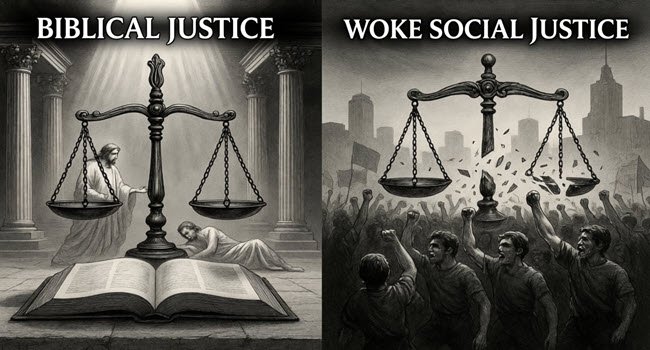
Few words are more contested today than “justice.” What Scripture presents as the righteous character of God and the equal dignity of every person is often confused with a modern ideology that measures justice by group identity, power dynamics, and equal outcomes.
This essay clarifies the difference. It examines the biblical framework in both the Old and New Testaments and contrasts it with contemporary woke social justice. The goal is simple: to recover clarity so that the church does not exchange the gospel for a rival vision of the world.
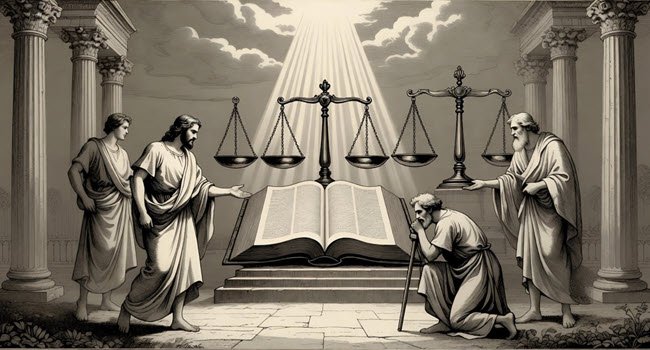
The Biblical framework for Social Justice
The Biblical framework for social justice, rooted in the character of God and the covenantal life of His people, differs fundamentally from the contemporary “woke” conception of social justice in its anthropology, its diagnosis of injustice, its remedies, and its ultimate end. Where Scripture begins with the equal dignity of every human being as an image-bearer of God and the shared reality of human sinfulness, the modern ideology begins with group identity and a hierarchy of oppression. Where the Bible diagnoses injustice as the fruit of disordered hearts and broken covenant, the woke framework locates it primarily in impersonal systems of power. Where Scripture calls for repentance, impartial law, personal responsibility, and voluntary generosity, the contemporary approach often relies on collective guilt, preferential treatment by identity, and coercive redistribution. And where biblical justice looks forward to the day when God Himself will establish lasting shalom, the woke vision remains almost entirely this-worldly, seeking a utopian rearrangement of power and resources through human effort alone.
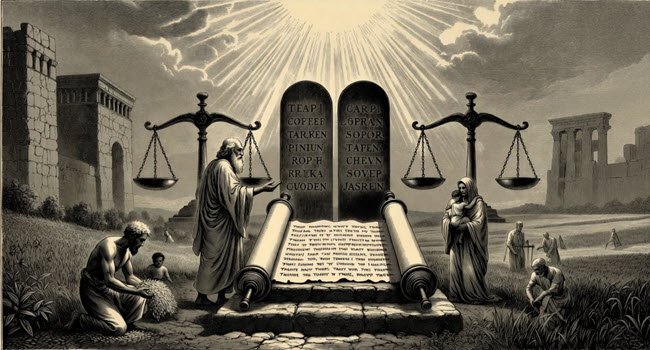
Social Justice
Old Testament Foundations
In the Hebrew Scriptures, justice (mishpat) and righteousness (tzedakah) are inseparable from the holiness of Yahweh. God is the defender of the vulnerable—the widow, the orphan, the sojourner, and the poor—not because they form an oppressed class with permanent moral superiority, but because they are made in His image and because covenant society is required to reflect His impartial character (Deuteronomy 10:17–19; Psalm 82; Isaiah 1:17).
Concrete provisions appear throughout the Torah: gleaning laws that leave the edges of fields for the needy (Leviticus 19:9–10; Deuteronomy 24:19–22), the prohibition of partiality in judgment whether toward rich or poor (Leviticus 19:15; Exodus 23:3), the cancellation of debts in the sabbatical year and the restoration of land in the Jubilee (Leviticus 25), and the requirement of honest weights and measures. Prophets such as Amos, Micah, and Isaiah denounce the powerful who crush the weak, yet they never frame the problem as an impersonal “system” that must be dismantled by revolution. Instead they call for repentance, return to the covenant, and the personal and communal practice of righteousness. Private property is affirmed; envy is condemned; and justice is measured against an objective divine standard rather than against equal outcomes.
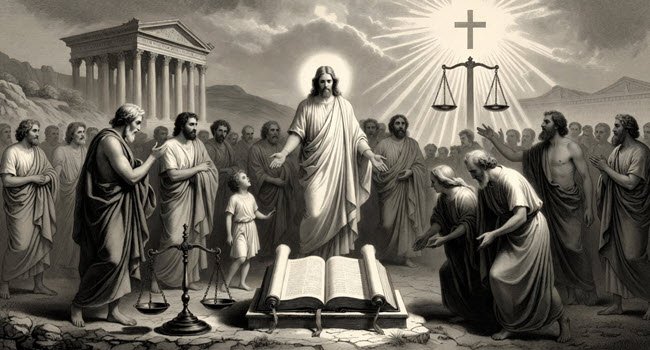
Social Justice
New Testament Continuity and Transformation
Jesus and the apostles intensify the moral demand while relocating its center. The second great commandment—“love your neighbor as yourself”—and the parable of the Good Samaritan expand the circle of obligation beyond ethnic Israel. The final judgment scene in Matthew 25 identifies care for the hungry, the stranger, the sick, and the prisoner with service to Christ Himself. Yet the New Testament never presents material redistribution or the abolition of social hierarchies as the essence of the gospel. Spiritual poverty is primary (Matthew 5:3); the kingdom is “not of this world” (John 18:36); and believers are urged to submit to governing authorities even under pagan Rome (Romans 13:1–7).
Equality in Christ (Galatians 3:28) is a spiritual reality that relativizes worldly distinctions of ethnicity, social status, and sex without erasing created differences or authorizing coercive leveling. Generosity is voluntary and cheerful (2 Corinthians 9:7); the early church’s sharing in Acts 2 and 4 is spontaneous, temporary, and motivated by joy in the resurrection, not by an ideology of equity. The New Testament diagnosis remains the same as the Old: the root problem is sin—individual and corporate rebellion against God—and the remedy is repentance, faith, regeneration, and the slow formation of a people who practice justice as an overflow of grace.
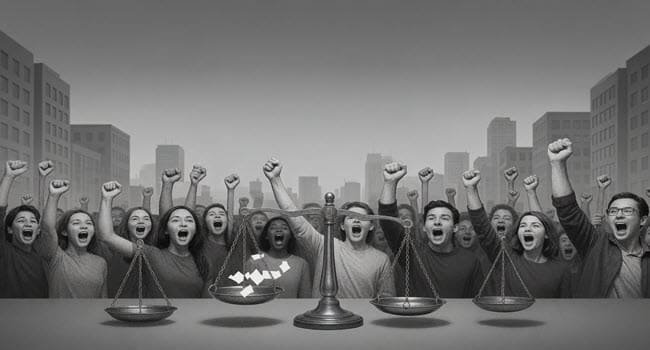
The Contemporary Woke Framework
By contrast, the dominant contemporary version of social justice—often labeled “woke”—draws heavily from critical theory, neo-Marxist analysis, and intersectionality. Injustice is understood primarily as the product of interlocking systems of power that privilege certain identity groups (especially along lines of race, sex, gender identity, and sexual orientation) while oppressing others. Moral status is assigned collectively: membership in a historically dominant group confers inherited guilt and “privilege”; membership in a marginalized group confers epistemic authority and a claim on rectification. Equity—roughly equal group outcomes—replaces equality under law or equality of opportunity as the operative ideal. Speech, institutions, and even biological categories are treated as sites of power that must be continually re-engineered. The preferred instruments are state power, corporate policy, educational capture, and cultural pressure rather than personal conversion or voluntary charity.
Core Differences
Several contrasts follow directly.
First, anthropology. Biblical justice begins with the equal dignity of every person as an image-bearer of God and the equal moral accountability of every person as a sinner. Woke justice begins with group location in a hierarchy of oppression; individual moral agency is secondary or derivative.
Second, the nature of the problem. Scripture treats injustice as the fruit of disordered loves and broken covenant. Woke analysis treats it as the structural expression of power differentials that can, in principle, be engineered out of existence.
Third, the means of remedy. Biblical justice relies on law that protects persons and property, prophetic confrontation that calls for repentance, and voluntary generosity empowered by the Spirit. Woke justice frequently relies on compulsory redistribution, viewpoint discrimination, and the dismantling of inherited institutions judged to be irredeemably tainted.
Fourth, the horizon. Biblical justice looks toward the day when God Himself will judge the world in righteousness and establish everlasting shalom. Contemporary woke justice is almost entirely immanent; its promised land is a this-worldly arrangement of power and resources.
Conclusion
The Societal Harm of Woke Theology
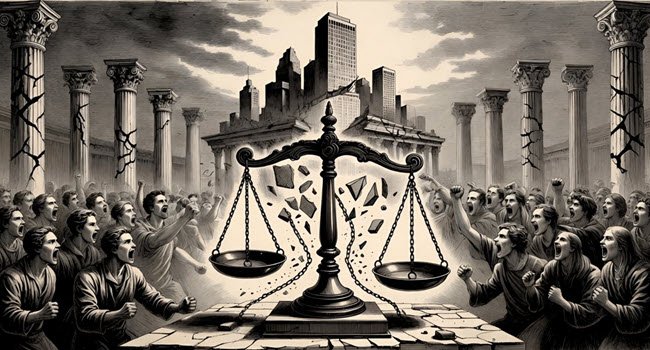
When the biblical vision of justice is displaced by woke theology, the damage extends far beyond academic debate. By redefining justice as the perpetual struggle between identity groups rather than the impartial application of moral truth, this framework fractures social trust. It teaches people to see one another first as oppressors or victims rather than as individual moral agents equally accountable before God. The result is heightened resentment, diminished personal responsibility, and a culture that rewards grievance over gratitude and reconciliation.
Institutions suffer as well. Schools, workplaces, churches, and governments increasingly prioritize group outcomes and ideological conformity over competence, free inquiry, and equal treatment under the law. Speech is constrained, dissent is pathologized, and complex human problems are reduced to simplistic power narratives. Charity is replaced by coercion, forgiveness by perpetual penance, and hope by an endless cycle of activism that never arrives at peace.
In the end, woke theology offers no lasting shalom. It cannot, because it rejects the very foundations that make genuine justice possible: the equal dignity of every image-bearer, the reality of personal sin, the possibility of repentance, and the authority of a holy God who judges without partiality. A society that embraces this substitute may gain temporary moral fervor, but it loses the deeper resources needed for human flourishing, social cohesion, and true righteousness.