
Servant of Christ
Dispensationalism
Foreword
Dispensationalism
Classic Definition of Dispensationalism
Dispensationalism is a system of biblical interpretation that views the history of God’s dealings with humanity as divided into distinct periods or “dispensations” (from the Greek oikonomia, meaning household management, stewardship, or administration). In each period, God tests humanity under a specific revelation of His will, revealing progressive stages in the outworking of His eternal purpose. The system, systematized in the nineteenth century by John Nelson Darby and popularized through the Scofield Reference Bible, emphasizes a consistent grammatical-historical (literal) hermeneutic, a sharp distinction between ethnic/national Israel and the Church, and the glory of God as the ultimate purpose of history rather than human salvation alone.
1. Definition of Dispensationalism
a. General Terms
Charles Ryrie, a leading twentieth-century articulator of the system, defined a dispensation as “a distinguishable economy in the outworking of God’s purpose.” God administers His household (the world) according to successive arrangements that mark progressive stages of revelation. The classic Scofield scheme lists seven:
- Innocence (Eden, Gen. 1–3)
- Conscience (Fall to Flood, Gen. 3–8)
- Human Government (Noah to Babel, Gen. 9–11)
- Promise (Abraham to Sinai, Gen. 12–Exod. 19)
- Law (Moses to the Cross/Pentecost, Exod. 20–Acts 1/2)
- Grace (Church Age, Acts 2 to the Rapture)
- Kingdom (Millennium, Rev. 20)
Dispensationalism Unmasked
Unmasking Dispensationalism reveals several interrelated reasons for opposition.
First, some have used it to teach that people can be saved by keeping the law. We already see this error in the New Testament with the Judaizers, who told Gentile believers that faith in Jesus was not enough—they also had to be circumcised and obey the law of Moses (Acts 15:1, 5). Paul called this “a different gospel” and insisted that we are justified by faith in Christ alone, not by works of the law (Galatians 1:6–9; 2:16; 3:10–11). The same mistake still appears today when people claim that Jewish people, or anyone else, can be right with God simply by following the Torah without trusting Jesus as the Messiah.
Second, Dispensationalism breaks apart the unity of the Bible and the single story of God’s saving work. It treats the old covenant given through Moses as if it were a permanent arrangement for ethnic Israel, when in reality that covenant was temporary. Scripture is clear on this point. In Hebrews 8:13 we read, “In speaking of a new covenant, he makes the first one obsolete. And what is becoming obsolete and growing old is ready to vanish away.” The writer goes further in Hebrews 8:6–13, quoting Jeremiah 31:31–34 and explaining that the new covenant is “better” and built on better promises. By announcing a new covenant, God has already made the old one obsolete. Jeremiah himself had declared that God would make a new covenant “not like the covenant that I made with their fathers… which they broke” (Jeremiah 31:31–32). Paul says the same thing: the law “was added because of transgressions, until the offspring should come” and served only as a guardian until Christ came (Galatians 3:19, 23–25). In 2 Corinthians 3:7–11, he even calls the old covenant a “ministry of death” whose glory was fading, while the new covenant ministry of the Spirit is permanent. The new covenant is not a separate plan for a different people. It is the full completion of the same covenant of grace first promised to Abraham. In Christ the wall between Jew and Gentile is torn down, and believing Jews and Gentiles become one new people who share the same promises (Ephesians 2:14–16; Galatians 3:14, 29).
Third, this system insists on a permanent separation between Israel and the Church as two peoples with two different futures. The apostle Paul teaches the opposite. He never says God has rejected Israel (Romans 11:1–2). Instead, he shows that belonging to God’s people has always been by faith, not by physical descent alone (Romans 9:6–8). In Romans 11, he pictures one olive tree whose root is the ancient promises to the patriarchs. Some natural branches were broken off because of unbelief, and wild branches—Gentile believers—were grafted in to share the same life. There is still only one tree, and the original branches can be grafted back if they turn to Christ (Romans 11:17–24). This leaves no room for two separate peoples of God.
By dividing history into disconnected stages and separating God’s people into two tracks, Dispensationalism obscures the steady unfolding of a single, continuous covenant of grace and pushes the cross of Christ out of its central place as the turning point for everyone (Romans 3:21–26; 2 Corinthians 1:20).
For all these reasons I reject Dispensationalism. It does not handle Scripture rightly and it weakens the beauty of God’s unified plan of salvation. The next sections of this essay will develop these points more fully by looking closely at Paul’s teaching on Israel and the olive-tree picture in Romans 11.
Pauline theology on Israel
Pauline theology on Israel is one of the most carefully argued and emotionally charged themes in the New Testament. Paul, a Pharisee who remained deeply attached to his people (Romans 9:1–5; Philippians 3:4–6), wrestles throughout his letters with the question of Israel’s election, the meaning of the covenants, the inclusion of the Gentiles, and the future of ethnic Israel in light of the gospel of Jesus Christ.
1. Foundational Convictions
Paul never abandons the conviction that God chose Israel:
- “They are Israelites, and to them belong the adoption, the glory, the covenants, the giving of the law, the worship, and the promises. To them belong the patriarchs, and from their race, according to the flesh, is the Christ” (Romans 9:4–5).
- “Has God rejected his people? By no means!” (Romans 11:1). Paul himself is living proof that God has not cast-off Israel.
At the same time, Paul radically redefines what “Israel” means in light of Christ:
- “Not all who are descended from Israel belong to Israel… It is not the children of the flesh who are the children of God, but the children of the promise” (Romans 9:6–8).
- The true “seed of Abraham” is Christ himself, and those who belong to Christ (Galatians 3:16, 29).
2. The Central Text: Romans 9–11
This section is Paul’s most sustained treatment. Its structure is deliberate:
- Romans 9: God’s sovereign freedom in election. The hardening of the majority of Israel is not arbitrary; it serves the larger purpose of bringing in the Gentiles and preserving a remnant “according to the election of grace” (9:27; 11:5).
- Romans 10: Israel’s failure is not due to lack of opportunity but to a pursuit of righteousness by works rather than by faith in Christ (10:3–4). The same Lord is Lord of all—Jew and Greek (10:12).
- Romans 11: The olive-tree metaphor is decisive. Israel is the cultivated olive tree. Some natural branches (unbelieving Jews) have been broken off because of unbelief. Wild olive shoots (Gentiles) have been grafted in and now share in the rich root of the patriarchs and the covenants. Yet the natural branches can be grafted back in again if they do not continue in unbelief (11:17–24).
Paul’s climax is the “mystery” of 11:25–26:
“A partial hardening has come upon Israel until the fullness of the Gentiles has come in. And in this way all Israel will be saved.”
Interpreters differ on the precise meaning of “all Israel”:
- Some (especially classic Dispensationalists) see a future national conversion of ethnic Israel distinct from the Church.
- Many others understand “all Israel” as the full number of the elect—believing Jews across the ages plus the grafted-in Gentiles—or as the eschatological remnant of ethnic Israel that turns to Christ at the end of the age, still within the one olive tree.
Paul’s own emphasis falls on continuity of the one people of God rather than on two parallel tracks.
3. Other Key Pauline Texts
- Galatians 3–4: The Abrahamic covenant is fulfilled in Christ. The law was a temporary guardian until the coming of the promised Seed. In Christ “there is neither Jew nor Greek” (3:28). The Hagar–Sarah allegory (4:21–31) sharply contrasts the present Jerusalem (slavery under the law) with the Jerusalem above (freedom).
- Ephesians 2:11–22: Christ has “broken down the dividing wall of hostility” and created “one new man” in place of the two. Gentiles are no longer “alienated from the commonwealth of Israel” but have been brought near and made “fellow citizens with the saints and members of the household of God.”
- 2 Corinthians 3: The old covenant (written on stone) is described as a ministry of death and condemnation that is “being brought to an end,” while the new covenant is the ministry of the Spirit that remains.
- Philippians 3: Paul counts his impeccable Jewish credentials as “rubbish” compared with knowing Christ. Ethnic privilege is relativized by union with the Messiah.
4. Theological Synthesis
Paul holds several truths in tension without resolving them into a simple scheme:
- Irrevocable gifts and calling (Romans 11:29) — God’s election of Israel is not revoked.
- Christological fulfillment — The covenants, promises, and identity of Israel find their “Yes” in Jesus (2 Corinthians 1:20). The Church does not replace Israel so much as it is the eschatological expansion and transformation of Israel around the Messiah.
- Remnant and hope — A remnant of ethnic Jews continues to believe in every generation, and Paul anticipates a future large-scale turning of Jewish people to Christ.
- One people of God — Jew and Gentile share the same root, the same olive tree, the same Spirit, the same inheritance. There are not two separate peoples of God with two separate destinies.
This Pauline vision stands in clear contrast to any system that treats the Church as a temporary “parenthesis” and restores a largely national, territorial, and covenantal distinctiveness to ethnic Israel in the age to come. For Paul, the decisive turning point is the cross and resurrection; the decisive identity is belonging to Christ; and the decisive hope is the full ingathering of both the fullness of the Gentiles and the salvation of “all Israel” into the one new humanity.
Romans 11 olive tree metaphor
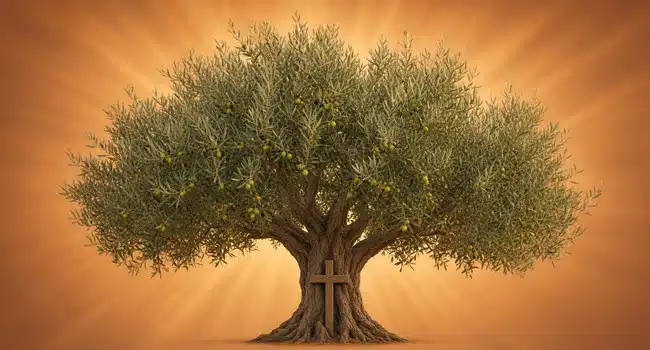
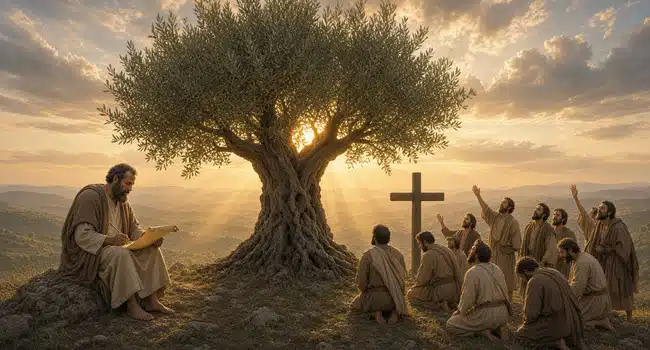
Romans 11:16–24 contains Paul’s most vivid and carefully constructed image for the relationship between ethnic Israel, believing Gentiles, and the one people of God: the cultivated olive tree.
Immediate Context
The metaphor follows Paul’s argument that God has not rejected his people (11:1–2), that a remnant according to the election of grace remains (11:5), and that the hardening of the majority of Israel has a temporary, instrumental purpose: the inclusion of the Gentiles (11:11–15). Verse 16 then introduces two parallel images of corporate holiness and continuity:
“If the dough offered as firstfruits is holy, so is the whole lump, and if the root is holy, so are the branches.”
The “firstfruits/lump” image draws on Numbers 15:17–21 (the offering of the first of the dough sanctifies the whole batch). The “root/branches” image shifts the focus to the olive tree and becomes the controlling metaphor for the rest of the section.
The Metaphor Explained
Paul develops the picture as follows:
- The cultivated olive tree represents the people of God in continuity with the patriarchal promises. It is not two trees, nor a new tree planted in place of an old one. There is one tree.
- The root is almost universally understood as the patriarchs (especially Abraham) and the covenant promises made to them. Some interpreters include the remnant of believing Israel or even Christ as the ultimate root, but the primary reference is the Abrahamic foundation that nourishes the whole tree (cf. Romans 4; Galatians 3).
- Natural branches = ethnic Israelites, the physical descendants of Abraham who historically belonged to the covenant people by birth and circumcision.
- Broken-off branches = those Israelites who have been severed because of unbelief (11:20). Their removal is not arbitrary or permanent in principle; it is the direct consequence of rejecting the Messiah.
- Wild olive shoots = Gentile believers. They are grafted in “contrary to nature” (11:24) — an agricultural practice that was known but unusual — and now share in “the nourishing root of the olive tree” (11:17). They do not create a new tree; they are inserted into the existing one.
Paul’s rhetoric is sharply pastoral and polemical toward Gentile arrogance:
- “Do not be arrogant toward the branches” (11:18).
- “It is not you who support the root, but the root that supports you.”
- The same God who did not spare the natural branches will not spare Gentile believers if they fall into unbelief (11:21–22).
- Kindness and severity stand side by side: severity toward those who fell, kindness toward those who stand by faith — provided they continue in that kindness.
Finally, Paul holds out explicit hope for the natural branches:
“And even they, if they do not continue in their unbelief, will be grafted in, for God has the power to graft them in again… how much more will these, the natural branches, be grafted back into their own olive tree” (11:23–24).
Theological Force of the Image
- One people, one tree The metaphor does not allow for two parallel peoples of God with separate covenants and destinies. Gentiles do not replace Israel; they are incorporated into Israel’s own olive tree. The Church is not a parenthesis or a new entity suspended between Israel’s past and future; it is the eschatological expansion of the same covenant people around the Messiah.
- Faith as the sole condition of belonging Branches remain or are restored only through faith; they are removed only through unbelief. Ethnicity neither guarantees nor permanently excludes. This relativizes physical descent while preserving the priority of the root (the patriarchal promises).
- Continuity of the covenants The “rich root” that nourishes both natural and grafted branches is the same Abrahamic promise that finds its “Yes” in Christ (2 Corinthians 1:20). The new covenant does not abolish the root; it brings the Gentiles into full participation in it and holds open the door for the natural branches to be restored.
- Warning and hope held together Gentile believers are warned against supersessionist pride. Ethnic Israel is not written off; the possibility — and, in the larger argument of 11:25–32, the expectation — of their re-grafting remains. The metaphor prepares for the “mystery” of the partial hardening “until the fullness of the Gentiles has come in,” after which “all Israel will be saved” (11:25–26).
Interpretive Notes
- The olive tree is not simply “the Church” in the abstract, nor is it ethnic Israel in a purely national sense. It is the historical people of God defined by the covenants and now centered on Christ.
- Paul’s language of “grafting contrary to nature” underscores both the surprising grace shown to Gentiles and the naturalness of Israel’s potential restoration.
- The metaphor is deliberately incomplete: Paul does not describe the tree’s final state in exhaustive detail. He uses it to establish continuity, dependency on the root, the danger of unbelief, and the real possibility of Jewish restoration by faith.
In short, the olive-tree metaphor is Paul’s most powerful visual argument that there is one covenant people of God, rooted in the promises to the patriarchs, expanded by the inclusion of the Gentiles through faith in the Messiah, and still open to the natural branches when they turn from unbelief. It stands as a decisive challenge to any reading that permanently separates Israel and the Church into two distinct olive trees or two parallel redemptive programs.
Conclusion
Paul’s picture of the olive tree in Romans 11 shows us something simple and powerful about God’s people. There is only one tree. Its roots go back to Abraham and the promises God made long ago. Some of the original branches—Jewish people who did not believe—were broken off. At the same time, wild branches—Gentile believers—were grafted in and now share the same life from those ancient roots. The tree itself never changed. There are not two separate trees or two separate groups of God’s people running on different tracks. Everyone who belongs does so by faith, and the door stays open for the original branches to be grafted back in if they turn to Christ.
This picture undercuts the idea that God works in entirely different ways across eras, treating Israel and the Church as two distinct peoples with separate futures. According to Paul, God has always had one people, and that people is defined by trust in Him, not by bloodline alone.
The same is true of God’s character. Grace, forgiveness, and love are not new inventions that started with the New Testament. They have always been the way God relates to people—from the very beginning. When Adam and Eve failed and broke their relationship with God, He did not abandon them. Instead, He sought them out, covered their shame, and established a new relationship with them based on His mercy. He even gave the first promise of a future Redeemer who would one day defeat the serpent. Abraham was counted righteous simply because he believed God, centuries before the law was given. David committed serious sins, yet found complete forgiveness when he turned back to God with a broken heart. Hosea’s faithful love for his unfaithful wife was a living picture of God’s own stubborn love for Israel, even when they kept wandering away. After the people made the golden calf, God did not abandon them. Instead, He revealed Himself as merciful, gracious, slow to anger, and full of steadfast love. The God who welcomes Gentile believers into the old olive tree is the same God who has always operated by grace.
So, the claim that history is divided into disconnected stages with different rules does not fit what Paul teaches. There is one root, one tree, and one people held together by faith in the Messiah. From Adam and Eve to Abraham to today, the same grace, the same forgiveness, and the same faithful love have been at work.
Though we look different and speak different languages, all who submit to God share one common voice—the voice that confesses Christ Jesus as Lord.