
Law of Moses vs. Law of Christ
Foreword
Few questions touch a Christian’s daily life more directly than this: Which law should I follow—the Law of Moses or the Law of Christ?
This essay reasons only from the moral law of Moses. The other two historic divisions of Moses’ legislation do not bind the church as a code.
The ceremonial law—sacrifices, priesthood, food laws, circumcision, feasts, and ritual purity—was a shadow of the good things to come. Once Christ, the substance, had come, the copies were no longer obligatory: “Therefore let no one pass judgment on you in questions of food and drink, or with regard to a festival or a new moon or a Sabbath. These are a shadow of the things to come, but the substance belongs to Christ” (Col. 2:16–17; cf. Heb. 10:1; Mark 7:19). The Jerusalem Council likewise refused to place Gentile believers under the full Mosaic yoke (Acts 15:28–29).
The civil and judicial law—the statutes that governed Israel as a nation in its land—expired with that theocracy. When the priesthood changed, the law bound up with it changed as well (Heb. 7:12), and the old covenant itself is declared obsolete (Heb. 8:13). Those laws may still instruct in justice, but they are not a constitution for the church or for modern states.
What remains, and what this essay will treat, is the moral law in substance: commands that reflect God’s character and how human beings are meant to live—Let us begin.
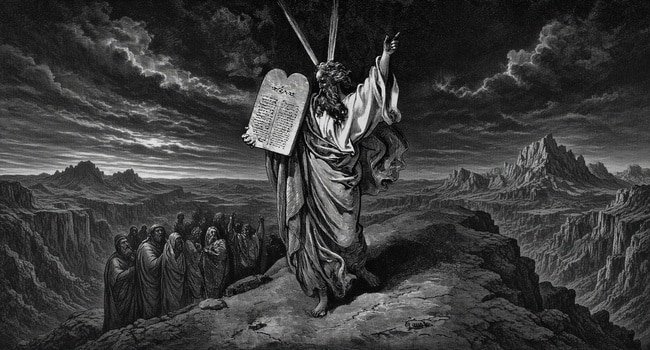
The Law of Moses as a Guide to Christ
and the Law Written on the Hearts of Believers
The Law given through Moses was holy, righteous, and good (Romans 7:12). It revealed God’s character, exposed sin, and ordered the life of Israel under the old covenant. Yet Paul states its purpose with precision:
“So then, the law was our guardian until Christ came, in order that we might be justified by faith. But now that faith has come, we are no longer under a guardian.”
— Galatians 3:24–25
The word translated “guardian” (or “tutor,” “schoolmaster”) describes a temporary supervisor whose role ends when the child reaches maturity. The Law of Moses, also known as the Mosaic Law, restrained, instructed, and pointed forward; it was never intended as the final form of God’s dealing with His people. It prepared the way for the Messiah by making sin known (Romans 3:20; 7:7) and by foreshadowing the perfect sacrifice and righteousness that only Christ could provide.
Jesus Himself confirmed both the Law’s divine origin and its fulfillment in Him:
“Do not think that I have come to abolish the Law or the Prophets; I have not come to abolish them but to fulfill them.”
— Matthew 5:17
Fulfillment means the Law reached its intended goal in Christ. The ceremonial system of sacrifices, purity regulations, and festival observances pointed to Him and found their completion in His death and resurrection (Colossians 2:16–17; Hebrews 10:1–14). The civil regulations given to national Israel no longer bind the multi-ethnic people of God under the new covenant. What remains is the moral substance of the Law, now internalized and empowered in a new way.

The New Covenant:
The Law Written on the Heart
“Behold, the days are coming, declares the Lord, when I will make a new covenant with the house of Israel and the house of Judah… I will put my law within them, and I will write it on their hearts. And I will be their God, and they shall be my people.”
— Jeremiah 31:31, 33
The writer of Hebrews cites this promise and declares that it has been inaugurated through Christ (Hebrews 8:6–13; 10:15–18). Under the old covenant, the law was external—written on tablets of stone. Under the new covenant, the same holy requirements are written by the Spirit on the hearts of believers. Paul echoes this reality:
“And you show that you are a letter from Christ delivered by us, written not with ink but with the Spirit of the living God, not on tablets of stone but on tablets of human hearts.”
— 2 Corinthians 3:3
“For the law of the Spirit of life has set you free in Christ Jesus from the law of sin and death.”
— Romans 8:2
This internal writing does not abolish the moral will of God; it transforms the believer’s relationship to it. Obedience is no longer motivated primarily by external compulsion or the threat of covenant curses, but by the indwelling Spirit who produces the fruit of love, joy, peace, and the other virtues that fulfill the Law’s deepest intent (Galatians 5:22–23; Romans 8:4).

The Law of Christ
What, then, is the governing standard for those who belong to Christ? Scripture calls it the Law of Christ:
“Bear one another’s burdens, and so fulfill the law of Christ.”
— Galatians 6:2
Jesus summarized its content:
“A new commandment I give to you, that you love one another: just as I have loved you, you also are to love one another.”
— John 13:34
“You shall love the Lord your God with all your heart and with all your soul and with all your mind… You shall love your neighbor as yourself. On these two commandments depend all the Law and the Prophets.”
— Matthew 22:37–40
Paul confirms the same:
“For the whole law is fulfilled in one word: ‘You shall love your neighbor as yourself.’”
— Galatians 5:14
“Love does no wrong to a neighbor; therefore love is the fulfilling of the law.”
— Romans 13:10
The Law of Christ is not a lesser or diluted ethic. It is the moral heart of the Mosaic Law, intensified by the example of Jesus’ self-giving love and made possible by the Spirit who writes that law upon the heart. Believers are not “under the law” as a covenant system of justification or national identity (Romans 6:14; Galatians 5:18), yet they are not lawless. They are under the Law of Christ—the law of love written within.

Which Law Should Believers Follow?
The Law of Moses, also known as the Mosaic Law, served its God-appointed purpose as a guide leading to Christ. Once faith in Christ has come, that temporary guardianship ends. The believer’s standing before God rests on the finished work of Christ, not on performance of the Sinai covenant. The ethical content of God’s will continues, but it is now received as the Law of Christ, inscribed on the heart by the Holy Spirit.
Therefore, those who trust in Christ are called to walk by the Spirit, fulfilling the law of love that has been written within them. They honor the Mosaic Law by recognizing its preparatory role and its fulfillment in Jesus; they obey the Law of Christ by loving God and neighbor in the power of the new covenant. This is not a rejection of God’s commandments but their true realization in the lives of those who have been made new.
An Example from Luke 14:5
Jesus does not treat the Sabbath as a rule to be discarded, nor as a fence that forbids mercy. When the Pharisees watch to see whether He will heal on the Sabbath, He asks:
“Which of you, having a son or an ox that has fallen into a well on a Sabbath day, will not immediately pull him out?”
— Luke 14:5
The question assumes what every hearer already knows: even under the Law of Moses, a life in danger overrides a rigid reading of the day of rest. The Law itself made room for necessity and compassion. Jesus does not invent a new loophole; He exposes the heart the Law always intended. The Sabbath was given for man’s good, not as a burden that leaves a son or an animal to perish.
Here the difference becomes plain. The Law of Moses command still names a holy rhythm. Christ fulfills it by showing that love of neighbor—immediate, costly, practical—is not a violation of that rhythm but its true keeping. Those who belong to Him are not released into lawlessness. They are taught to see the same holy will now written on the heart: do good, even when the calendar says wait.

Conclusion:
Law of Moses vs. Law of Christ
The question “Which law should I follow?” is answered by the movement of redemptive history itself. The Law of Moses was never meant to be the believer’s final master. It was a faithful guide that led Israel—and all who would later believe—to the Messiah. In Christ, that guide has completed its work. The new covenant does not leave God’s people without law; it places the law where it was always intended to dwell: on the heart.
To follow the Law of Christ is therefore not to abandon the holiness revealed at Sinai. It is to receive that holiness in its fulfilled form—written by the Spirit, animated by love, and lived out in union with the One who perfectly kept the Law and then bore its curse. Believers do not return to the guardian once the heir has come of age. They walk in the freedom of sons and daughters, with the law of God no longer an external code that condemns, but an internal reality that transforms.
This is the gospel’s answer: the Law of Moses, also known as the Mosaic Law, pointed to Christ; Christ’s law is now written on the hearts of all who believe. Follow Him.